Photography by John Berens
Born in Tallahassee, Florida, 1961 BFA – Cooper Union, 1985
Lives and works in Brooklyn, New York
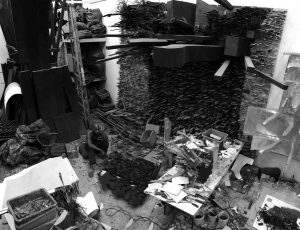
Practicing an evolutionary approach to his art, Leonardo Drew is in a constant state of making and unmaking his large-scale sculptural assemblages. “I just take old work and turn it into new work. There’s always layering and that happens because life is going on, so you’re layering your experiences.”1
Growing up in public housing in Bridgeport, Connecticut, Drew’s process is in uenced by his early memories of an adjacent land ll and rendering plant for soap. Seeing vehicles enter with dead animals, and the notion that the material we use to make us clean is derived from decay was formative: “And to this day I can still smell it. It still affects me and informs my creative oeuvre. Number 8, the mother to all of my works, speaks of that experience most eloquently.” 2
Instead of collecting found objects to create his works, he uses natural substances like wood, iron, cotton, and paper and then subjects them to a range of processes like staining and dyeing that mimics weathering, burning, oxidization, and decay. Creating sculptures in forms that move: they dangle, reach, ooze, lay, drip, drawing the viewer in, Drew leads us to examine the relationship between part and whole and to wonder how he mimics natural processes.
Using a categorization system for titles, Drew’s “L-” series was created in London, “T-”s were made in Texas, and “S-”s in San Francisco.3 The work 52S appears to be constructed of wood charred black, arranged into a tight but uneven grid evoking an aerial view of a metropolis with a cluster of pale interwoven branches that simultaneously spring forth and are swallowed in the center of the work.
Although initially recognized for his talent as a draughtsman and even recruited by Marvel Comics, DC Comics, and Heavy Metal Magazine, Drew knew he had to seek other ways of creating. “I was doing a lot of exhibiting of a type of work that showed off my facility, from when I was 13 up until my second year of college. I said, “Enough of this.” What I did was, “Tie your hands. No more drawing, no more painting. Find another way. You have to nd another way.” It took, if I remember, seven years – it was ’82 roughly to ’88, ’89. What ended up happening was Number 8 (The Mother). Numbers 1-7 became Number 8.4
1Ugelvig, Jeppe. “Leonardo Drew’s Undulating Wood Sculptures Question the Natural.” Artsy.net
2Proenza, Mary. “Leonardo Drew at Sikkema Jenkins.” ArtInAmericaMagazine.com. Brant Publications, January 8, 2013.
3Weiss, Haiey. “Leonardo Drew and The Mother.” InterviewMagazine. com. Jason Nikic, September 29, 2016.

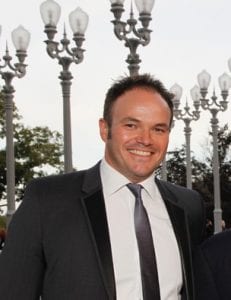 Christopher Bedford is the Dorothy Wagner Wallis Director of The Baltimore Museum of Art (BMA) and the 10th director to lead the museum, which is renowned for its outstanding collections of 19th-century, modern, and contemporary art. Recognized as an innovative and dynamic leader for building greater community engagement and creating programs of national and international impact, Bedford served as director of the Rose Art Museum at Brandeis University for four years prior to joining the BMA and was appointed as Commissioner for the U.S. Pavilion for the 2017 Venice Biennale, the world’s most prestigious contemporary art exhibition, which debuted an exhibition of new work by American artist Mark Bradford. Previously, Bedford held the positions of chief curator and curator of exhibitions at the Wexner Center for the Arts at The Ohio State University (2008-2012), where he organized a nationally traveling exhibition of the work of Mark Bradford. He also served as assistant curator and curatorial assistant in the Department of Contemporary Art at the Los Angeles County Museum of Art (2006-2008) and consulting curator in the Department of Sculpture and Decorative Arts for the J. Paul Getty Museum (2006-2008). Born in Scotland and raised in the United States and the UK, Bedford has a Bachelor of Arts from Oberlin College, received a master’s degree in art history through the joint program at Case Western Reserve University and the Cleveland Museum of Art, and has studied in the doctoral programs in art history at the University of Southern California and the Courtauld Institute of Art at the University of London. Bedford is also a noted author and contributor to publications including Art in America, ArtForum, and Frieze, among others.
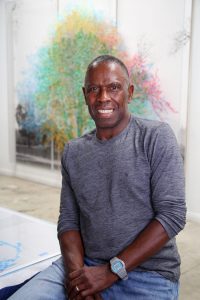
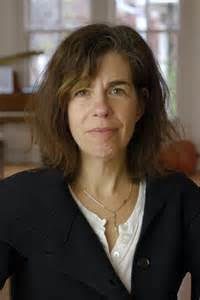 Katy Siegel is the inaugural Eugene V. and Clare E. Thaw Endowed Chair in Modern American Art at Stony Brook University, and Senior Curator for Research and Programming at The Baltimore Museum of Art. She is the co-curator with Christopher Bedford of Mark Bradford’s exhibition at the U.S. Pavilion for the 2017 Venice Biennale, and co-curator with Okwui Enwezor and Ulrich Wilmes of Postwar: Art Between the Atlantic and the Pacific, 1945-1965, at the Haus der Kunst, Munich. Past exhibitions have included Rosalyn Drexler: Who Does She Think She Is?. Pretty Raw: After and Around Helen Frankenthaler, Light Years: Jack Whitten, 1971-1974, and High Times Hard Times: New York Painting, 1967-75, which toured internationally and received an award from AICA. Her edited volumes include “The heroine Paint”: After Frankenthaler (2015) and Abstract Expressionism (2011); she is the author of Since ’45: America and the Making of Contemporary Art, which details the collision of American social history and European modernism (2011). She has written criticism and historical essays on contemporary and modern art for numerous institutions internationally, and is a Contributing Editor at Artforum, and Consulting Editor at The Brooklyn Rail. From 2010-2013 she was the Editor in Chief of Art Journal.